Wednesday, May 31, 2023

A Case for Mindless Dice Combat

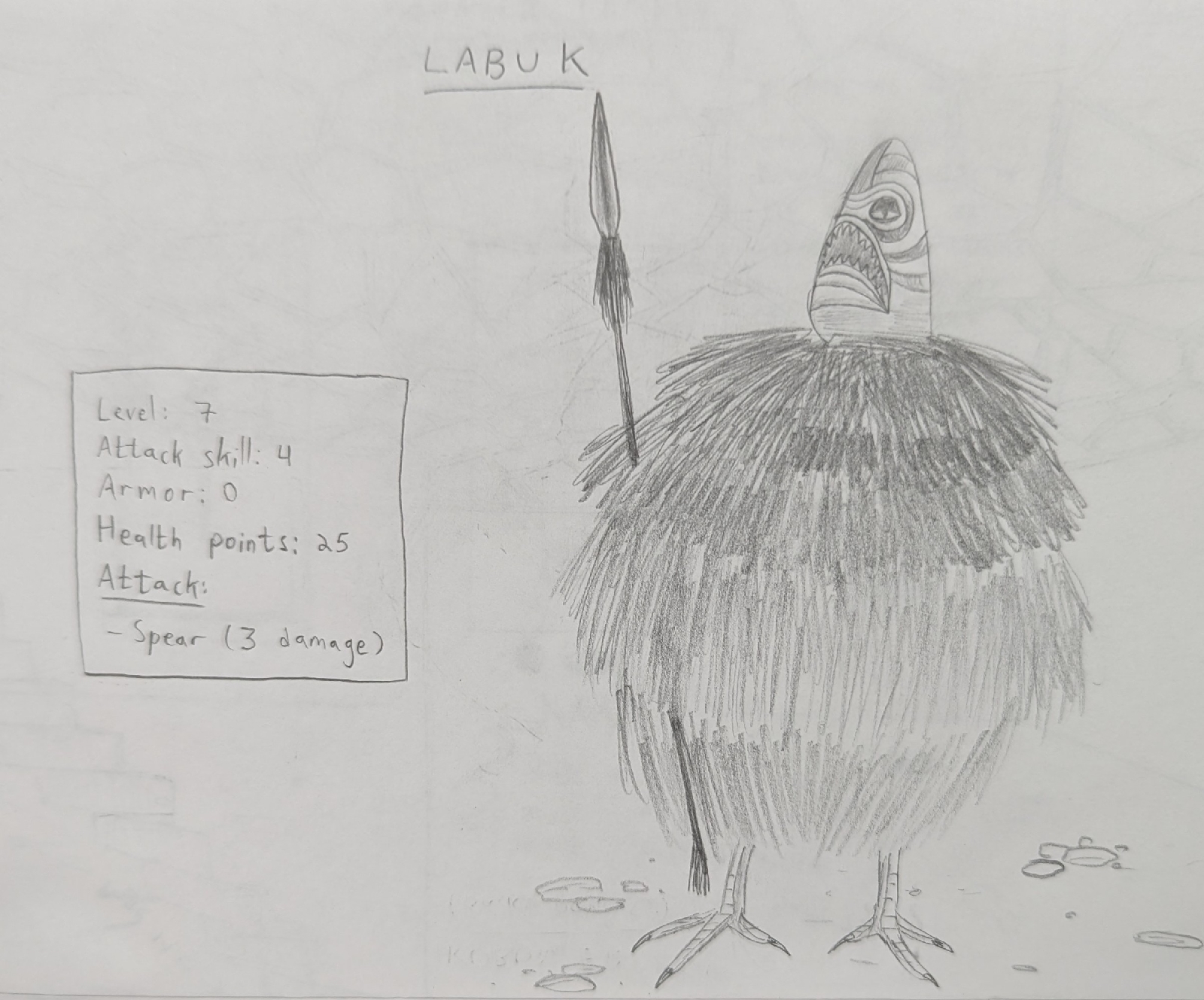
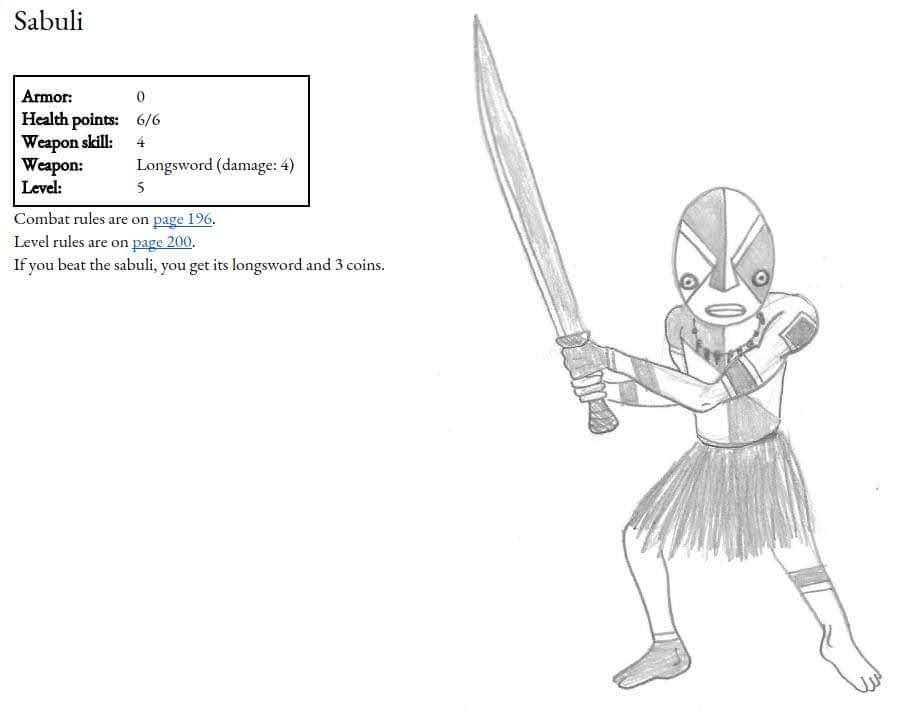
Many TTRPGs and gamebooks feature dice-based combat.
Designing this combat to allow player agency can be difficult (as illustrated in my previous blog post, Evolution of Gamebook Combat.)

Q) But doesn't removing player agency violate the basic premise of gamebooks and RPGs?
A) Usually. But mindless dice combat can have its uses.


1. Dice provide unpredictability.
Combat sections might not always be about choices, but about making outcomes feel open-ended and not predestined.
This can also lend a feeling of real danger, since things are out of the player's control and there is no clear safe path forward.
(Note that this is not so much as a game mechanic as it is a mood-setting narrative mechanic.)

2. There is fun in games of chance.
These games have been around for thousands of years; the earliest dice predate recorded history.
Players might not be making choices, but they're still having fun.

3. Physical interaction with dice is fun.
Place some dice on a table and sit beside them. Chances are you'll start rolling them and fidgeting with them just for the fun of it.
Gamebooks are read-heavy, making the players physically passive; having some physical actions to perform while playing can make a huge difference.

4. Sometimes people simply don't want to worry about choices.
Especially if the reader just wants to unwind. People have enough choices to worry about in Real Life. Let 'em just roll dice and have fun!

Remember:
Dice combat can add flavor if used sparingly and when necessary, like adding a pinch of salt when it's called for.
Too much is like a cup-full of salt; in the wrong place it's like putting salt in your tea.

Monday, May 22, 2023

Evolution of Gamebook Combat

This is not a post about combat in gamebooks.

It's a post about how my various trials and errors at making interested combat systems in my own hobby gamebooks, most of which were drawn in notebooks during school.

Space Game (2000)

Space Game was not my first gamebook, but it is the earliest one which I still have.
Combat was simple and turn-based. The player has no agency in combat whatsoever (though the player can select which missions to take, and which upgrades to make for the ship).

Blood of The Bloodless (2001)

I had made several games with simple d6 combat, most of which (except for Space Game) are unfortunately lost.
Eventually I became bothered by the fact the combat was mindless dice-rolling, amd resolved to make a game where actual player skill was required.

The result was Blood of The Bloodless.
In this dungeon-crawl, you don't just roll the die; you toss it.
From a distance.
And in order to hit, you had to actually hit.

The game fared surprisingly well among my classmates, despite the over-tedious of keeping track of how many hit-points remained in each body-part of your enemy (and there were a lot of enemies).
Enemies also spawned ramdomly (determined by dice, of course), a mechanic which I'd continue to use afterwards.

Mechwarrior 3.745 and Mechwarrior 7.45 (early 2000s)

These   ̶p̶l̶a̶g̶i̶a̶r̶i̶z̶e̶d̶ ̶̶ fan-games included several maps I'd made (and later lost). Combat was board-game-like, with specific objectives and scenarios.
Funnily enough, I had had no idea at the time that Battletech was originally a board game, and not just a series of video games.

In the earlier Mechwarrior 3.745, I still used the throw-your-dice-from-far mechanic from Blood of The Bloodless.
In Mechwarrior 7.45 I dropped this mechanic, for simplicity's sake.

Demise (mid 2000s)

Demise was a horror game where you fought demons.
I had come up with a system where you had a given amount of power, and were free to choose at any point how much to allocate for attack and how much for defense.
Getting hurt lowered your total power, which made combat even riskier.

It was a good idea, but not entirely ripe; choosing how to distribute your power was fairly obvious, and wasn't as challenging as I'd hoped.

The Legend of Kraati, Hetilla's Quest and an unnamed-and-unfinished game (2010s)

In these games I reverted back to simpe dice-rolling.
Skill was required mostly when deciding how to level up, and in solving puzzles.

The Legend of Kraati (on which I based the Android game Planet 404) had two different combat systems, which helped keep combat a little more interesting:
The Return of Zaltec (2020)

My first published game ☺️
...and the combat system isn't that great.
Players can make choices when they level up, and players can make choices if they happen to have chosen to focus on magic combat.

This alone isn't too bad.
The problem is that there's a lot of combat in the game, with little reward, and it becomes tedious after a while.

Fortunately, Zaltec's strong point is not the combat, but the puzzles (and people cheat anyway in combat, so it's no big deal).
Still, I wanted to improve this, which I did in

Zaltec II: The Generation Stone (2022)

In Zaltec II, I added a fight-or-flight mechanic, allowing players to attempt to flee from any fight.
When leveling up, players can choose to get better at evasion, which also lowers the chances of facing combat encounters altogether.

Here, too, the selling point of the book are the puzzles rather than the combat; the fighting serves to add a sense of adventure and challenge.

Tuesday, April 18, 2023

Can Gamebooks Offer Infinite Replayability?

TL;DR - theoretically.
(But easier said than done.)

Gamebooks are typically made to be played again after reaching an ending. This is true for choose-your-own-adventure books with mutiple paths and endings; for solo RPGs where the player character might die in combat; or adventures such as Fighting Fantasy which include both combat and branching plots.

But how many times can a game be replayed?

For games with branching paths and endings, a game can theoretically be replayed until all possible paths have been explored (or until the reader found the One Good Ending™ and has no further reason to play, or until the reader has reached enough endings to get bored and just flip through the book).
But even when replaying, the reader will probably just return to one of the forks along the path, and not re-read thrle whole thing each time they go through it.

In games where replayability comes from character death, on the other hand, the replayability isn't done for the sake of playing the game again, but just as another attempt to get past the unfinished challenge.
This isn't necessarily a bad thing; the real possibility of losing makes the eventual victory so much more rewarding.

Games focused on puzzles, such as my own Zaltec games, have very little replayability (beyond the aforementioned death-induced retry), as puzzles can typically be solved just once.
(Unless a puzzle can have several possible correct answers, which is a really cool idea I'd like to tackle some day.)

Bottom line?
Gamebooks can be played a few times, and that's it.

So how can a game be made to allow infinite replayability?

Here are some ideas:

0. Computer-generated storylines and characters
That's basically a computer game or Interactive Fiction, not a classical gamebook.
Let's move on.

1. Random-tables for generating storylines and characters
Better.
A gamebook can include tables for rolling dice and adding elements to the story based on the results.
These random tables can be used to generate landscapes, combat encounters, non-player characters, goals and missions, dungeons, environments, and more.
While such random-generation might not be truly infinite, they can be combined to create nearly-infinite possibilities.

This kind of system has its downsides, of course:

- Downside the First:
It's difficult to randomly-generate high-quality narrative beyond elements within the story.

- Downside the Second:
Although each playthrough is technically different, it can still often feel the same to the readers; and we're discussing replayability value, not just "how many times can the game be altered."

- Downside the Third:
Such randomization makes the gamebook become more similar to a board game than a story (which might not be a bad thing if that's what the players are looking for).
Readers often turn to gamebooks for the sake of immersion and exploration.

These problems can be worked around, but it isn't easy.
And, of course, you can't randomize puzzles.

OR CAN YOU?
I plan to write a dedicated blog post just for that.
Spoiler: Consider the game of chess.

...and speaking of chess, here's the final idea:

2. Some kind of system where the elements of the story are not pre-written
Not in different branches, and not in random-tables.
Consider, as I mentioned, the game of chess.
- The game has consistent rules that don't require infinite writing, and yet -
- The rules allow the game to develop in practicially inifinite different ways (OK, not mathematically infinite, but still more possibilities than there are atoms in the universe (and there are a darn lot of atoms in the universe)).

Could a game system be written that allows the story to develop differently every time, like in chess?
Could such a system enable creating different characters, places, motivations, and backstories each time?
How could such a system be run by a single player, without a game master (like in TTRPGs) or a computer program (like in computer programs)?

I don't know.
But I hope to find out some day.

Sunday, April 2, 2023

Page-Number Puzzles

Gamebooks typically tell which pages or sections you may turn to. This is standard, and is the whole premise for Choose Your Own Adventure.

However, some gamebooks include page-number puzzles. These puzzles allow players to proceed to a next section by solving a puzzle, whose answer is the section number.
These puzzles can serve two main purposes:

1. They ensure players only procede after meeting some story requirement, such as obtaining an item or speaking to some character.
This sort of puzzle is found in such gamebooks as the Fighting Fantasy series.

2. They add a puzzle element for its own sake.
These puzzles are features in gamebooks such as Sorcery! and my own gamebooks, the Zaltec duology.

Here are some important things to keep in mind when creating such puzzles:

1. Make sure there is only one correct answer.

Consider the following theoretical puzzle in a gamebook:
"x+y=7. Go to page x*y."
The designer might mean the answer is page 12 (with x=3, y=4). But players might end up on page 5*2, or 6*1, or -170 (with x=17, y=-10).

It's very easy to make this mistake. Gamebooks do not have an "external referee" such as a Game Master or videogame code to make sure players don't end up on the wrong page.

Make sure to have people play-test your puzzles!

2. Make it obvious to the readers that they are meant to turn to the numbered page of section.

If they solve a riddle and end up with "42", they might not understand that they need to that section. There are various ways to make it clear, such as adding text; setting precedence earlier in thrle book; or making it visually obvious, such as by presenting the puzzle on a locked door.

3. Make it clear to the readers that the correct answer is the correct one, and an incorrect answer is incorrect.

Since there is no referee there to let the readers know whether they solved the puzzle correctly, the correctness of puzzles should be self-evident.

For this reason, plain old math problems are problematic (tee hee!). A reader might get the answer wrong and not realize it.

Some ways to deal with this:

- Use non-whole numbers, with the solutiom being whole (so if readers end up with 23.189994, they'll realize they got it wrong).

- Use puzzles whose answers produce text!
A cipher which translates to "GO TO PAGE TWENTY" will be clearly correct to the readers.

4. Have people playtest in order to gauge difficulty.

It's very hard to estimate how hard a puzzle is, when you already know the solution.

5. A good puzzle should make readers feel smart.

I wish I knew a method to accomplish this. I can only bring this up as something to strive for and to attempt to measure puzzles by.

Friday, March 24, 2023

Puzzle Script Tips

Made-up scripts and ciphers can be great for puzzles, whether for tabletop role-playing games, escape rooms, or gamebooks.

Beyond just providing a mere puzzle, a script can also set the theme and add flavor.
Here are a few guiding principals to keep in mind when designing a script for a puzzle:

1. Readers should be able to tell letters apart (unless telling them apart is the actual puzzle).

2. If readers will need to write down the letters as part of solving puzzles, the letters should be easy to write.
3. Letters should ideally have enough "character" (no pun intended) that they are easy to remember.
It might get frustrating for players to constantly need to consult a reference in order to decrypt each individual letter when they're trying to read something.
These are just guides, and they're meant to be broken.

Sometimes for a puzzle's sake you'll want the letters to look alike, so that they can rotate and become other letters. Or make the streets of a city map form a hidden message.

It's your call.
One more thing to consider is inclusiveness.
Would people with dyslexia have a hard time with your script? What about other visual impairments?
You can't always solve this (especially not with a graphic-heavy puzzle game), but it's something to always keep in mind.

Thursday, March 23, 2023

Gamebooks Dos and Don'ts

Gamebooks combine storytelling with interactivity, allowing the reader to make choices that affect the outcome of the story. Choices (and, quite often, combat) are critical elements of gamebooks, and they play a significant role in making the experience enjoyable for readers. Here are some dos and don'ts of making choices and combat in gamebooks be fun.
Dos:
  1. Choices should matter: Some choices mighy serve to provide personal flavor and style, but otherwise choices should actually affect the story.

  2. Signal the consequences! Players musy understand their choices. They should have some idea of where the choice might lead. And once they face the consequences, they should feel that it's because of their choice and not because The Author Decided To Say So.

  3. Combat should enrich the story: Combat is an integral part of many gamebooks, but it needs to serve a purpose. It can advance the plot, or make the player feel heroic, or add a sense of real danger to the game.

  4. Combat should be fun: Enough said.

  5. Paths should be rewarding: Readers should want to explore different paths. Different paths should let them explore the world, the story, the lore, various characters, and sub-plots.

  6. Make satisfying endings: Not all endings have to be good, but they must be satisfying. Bad endings can serve to make the good endings more meaningful and rewarding, so they do serve a purpose; but they should make the readers feel engaged rather than enraged.

Don'ts:

  1. Don't do the opposite of the Dos section.

  2. Don't make combat too easy.

  3. Don't make combat too difficult.

  4. Don't add combat as a space-filler.

  5. Don't make only One True Path.

  6. Don't covet they neighbor's house.

  7. Don't drag readers along multiple passages if they're headed toward a bad ending. Get it over with quickly.

In conclusion, making choices and combat in gamebooks be fun is all about finding the right balance. Meaningful choices, engaging combat, consequences, and multiple paths can all contribute to a fun and enjoyable gamebook experience.

I have made more than one of these mistakes in my own gamebooks, and I'll probably make new mistakes in the future. So if you've got any tips of your own, please let me know in the comments!

Wednesday, March 22, 2023

Hello, worlds

If you're reading this, you're probably a nerd like me. And if you're a nerd like me, you probably love roleplaying games, puzzles, and gamebooks.

But what if I told you that these were more than just a fun way to spend an evening? What if I told you that they could actually make you smarter?

I'd be lying, that's what. However, games are a great way to spend time.

In this blog, I plan to wrote about a variety of topics related to gamebooks, TTRPGs, and puzzles. I'll be sharing my thoughts on new gamebooks, tips for running a successful game, my own puzzles for others to solve, and tips on good puzzle design.

I hope you'll join me on this journey! I'm excited to share my passion for gamebooks, TTRPGs, and puzzles with you.

Welcome.